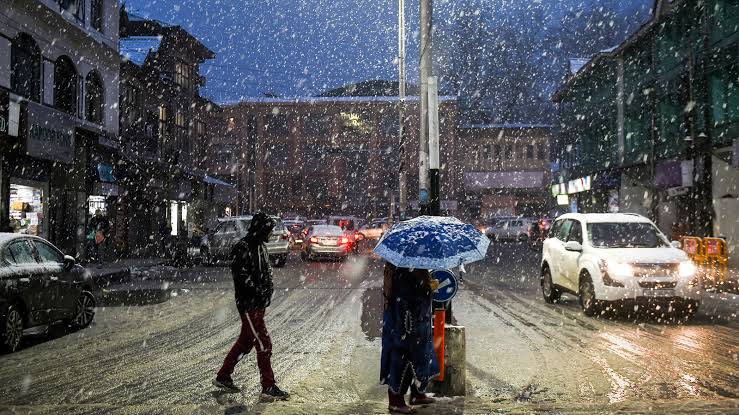





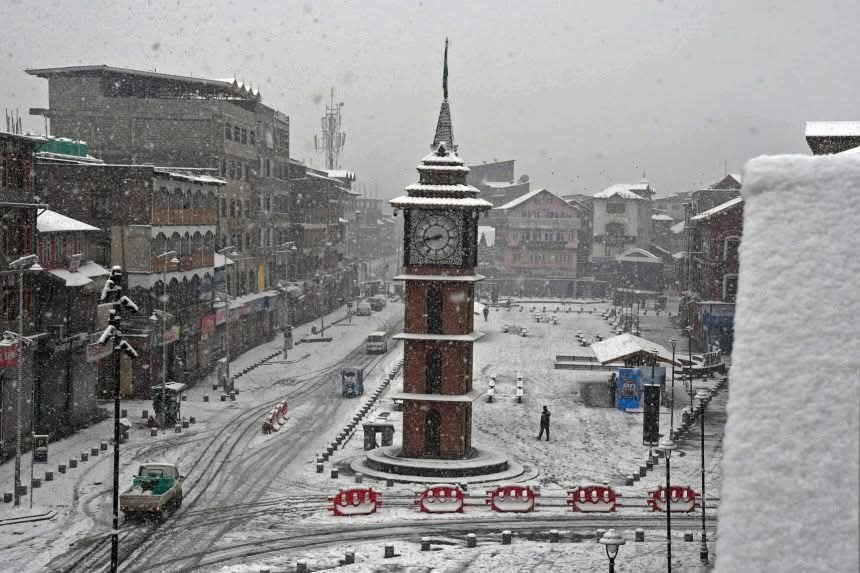
Srinagar, Jan 21 (KNO): Minimum temperatures across Jammu and Kashmir and Ladakh showed mixed trends on Wednesday compared to the previous day, with several places in the Kashmir Valley recording a slight rise in night temperatures, while parts of the Jammu region and higher reaches witnessed a further dip, even as the weatherman predicted rain and snowfall from Thursday.

According to the news agency—Kashmir News Observer (KNO), in the Kashmir region, Srinagar recorded a minimum temperature of minus 2.4 degrees Celsius on Wednesday, up from minus 3.4 degrees a day earlier.
The temperature at Srinagar Airport also rose by one degree, settling at minus 3.4 degrees Celsius compared to minus 4.4 degrees on Tuesday.
However, Qazigund saw a drop from minus 2.3 degrees to minus 3.3 degrees Celsius, while Kupwara recorded a sharper fall from minus 1.2 degrees to minus 3.0 degrees. Pahalgam remained largely unchanged, recording minus 3.8 degrees compared to minus 4.0 degrees the previous day.
Gulmarg marginally improved from minus 5.5 degrees to minus 5.0 degrees, while Sonamarg recorded a rise from minus 6.2 degrees to minus 5.5 degrees Celsius. Pulwama and Shopian continued to remain among the coldest places in the Valley, with Shopian recording minus 5.5 degrees on Wednesday.
In the Jammu region, Banihal recorded a further dip, with the minimum temperature falling from minus 1.6 degrees to minus 2.3 degrees Celsius. Bhaderwah also saw a decline from minus 1.2 degrees to minus 1.8 degrees.
Jammu city recorded a marginal fall from 7.4 degrees to 7.2 degrees, while Samba slipped below freezing, recording minus 0.1 degrees compared to 0.4 degrees a day earlier.
In Ladakh, Leh recorded a minimum temperature of minus 9.0 degrees Celsius, while Hanle remained the coldest place at minus 13.3 degrees.
Meanwhile, the India Meteorological Department (IMD) issued a weather advisory warning that two western disturbances in quick succession are likely to affect Jammu and Kashmir and adjoining areas from January 22 to 24 and again from the night of January 26 to the forenoon of January 28.
According to the advisory, the first western disturbance, expected to be intense, will impact the region between January 22 and 24, with peak activity on January 23. The second system, of moderate intensity, is likely to affect the Union Territory from the night of January 26, with peak activity on January 27.
Under the influence of these systems, widespread light to moderate rain and snowfall is expected across Jammu and Kashmir, with heavy rainfall or snowfall at isolated places, particularly over the Pir Panjal range, including the Chenab Valley of Jammu division, and the middle and higher reaches of south Kashmir.
Areas likely to be affected include Anantnag, Pahalgam, Kulgam, Shopian, Pir Ki Gali, Gulmarg, the Sonamarg–Zojila axis, Bandipora–Razdan Pass, Kupwara–Sadhna Pass, and the districts of Doda, Udhampur, Reasi, Kishtwar and Ramban.
The IMD said the weather systems may lead to disruption of surface and air transport, including the Jammu–Srinagar National Highway and other major roads in the middle and higher reaches of the Union Territory.
There is also a possibility of landslides, mudslides and gusty winds with speeds of 40–60 kmph at vulnerable locations.
Travellers, tourists and transporters have been advised to plan their movement accordingly, while residents of snow-bound areas have been asked to avoid venturing into avalanche-prone zones—(KNO)